
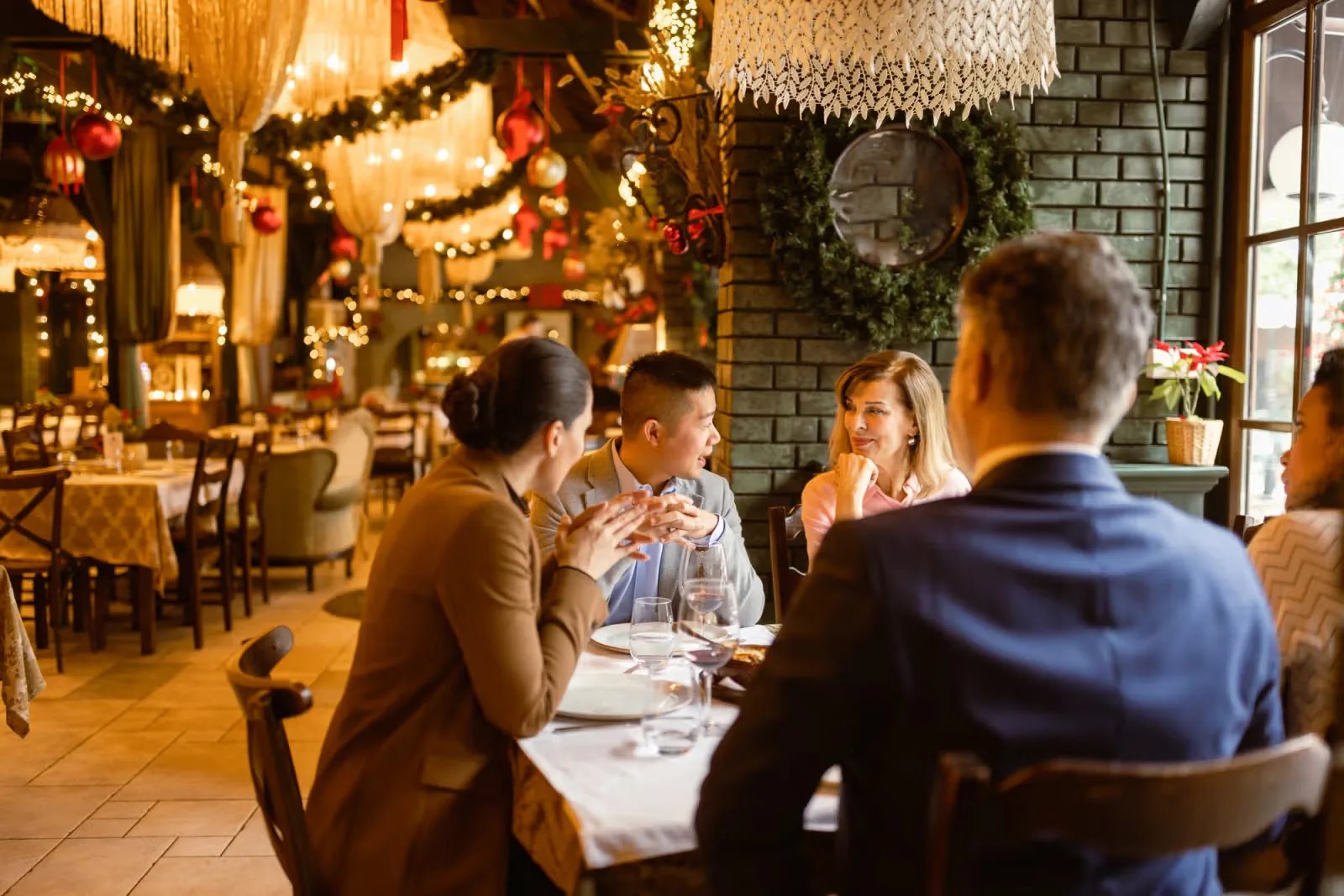
The holiday season is the highest-intent dining window of the year. Guests are booking group dinners, ordering catering for office parties, buying gift cards, and choosing where to take family who are in town. Most of those decisions start on Google or in a social feed.
The demand shows up in the data. Across Popmenu restaurants last season, weekly online orders driven by Google Ads ran about 30% above fall levels in the first three weeks of December, and store visits peaked around 67% above a normal week from mid-December into early January.
This guide pulls together research and client results from Popmenu, so you can put each tactic in motion before the rush.
Jump to
How can restaurants increase holiday sales?
Restaurants increase holiday sales by meeting guests where they decide (Google and social), giving them specific, orderable offers with a price and a deadline, and making it easy to order directly. The six highest-impact moves for the 2026 season include:
- Launch Google and Meta ads 4 to 6 weeks before each holiday, so campaigns finish their 1 to 2 week learning phase before demand peaks.
- Update the ordering links on your Google Business Profile and set your own online ordering as the preferred option.
- Promote holiday catering and party packages to offices, families, and groups.
- Run ordering events and holiday pre-orders with a set menu, a clear price, and a pickup window.
- Sell tickets to holiday events like New Year’s Eve dinners, wine dinners, and tasting menus.
- Sell gift cards and bring holiday guests back in January with email, text messages, and loyalty.
Run Google and Meta ads before holiday demand peaks
Google and Meta ads do different jobs, and the strongest holiday plans use both. Google captures demand from guests who are already searching, like “holiday catering near me” or “Christmas Eve dinner.” Meta creates demand by putting your food in front of local guests while they scroll Facebook and Instagram.
Timing matters as much as budget. New campaigns need about one to two weeks to learn who your best guests are, so a campaign launched in mid-December is still learning during peak demand. Across Popmenu restaurants, Google Ads-driven online orders and store visits started climbing in late October, which means the best time to launch is four to six weeks before each holiday.
Google Ads: show up when guests are ready to decide
Google Search ads put your restaurant at the top of results for high-intent searches. Performance Max extends one campaign across Search, Maps, YouTube, Gmail, and more, so guests see you while they get directions or watch videos.
Foster’s Kitchen in Hawaii combined both campaign types in Q3 2026. Search and Performance Max drove 112 online orders, nearly $3,300 in online revenue, and close to 3,000 store visits. Performance Max alone delivered more than 200,000 impressions and nearly 12,000 website visits.

- 112online orders
- $3.3Konline revenue
- 3Kstore visits
- 200K+impressions
- 12Kwebsite visits
To get the most from Google Ads this season:
- Bid on both brand and non-brand keywords. Brand terms (your restaurant’s name) are inexpensive and protect you from delivery apps and competitors bidding on your name. Put most of your budget on non-brand terms like “holiday catering near me,” “Italian in [neighborhood],” or “private dining.”
- Use exact and phrase match. Broad match can work for large budgets, but for a local restaurant it often spends on searches that never turn into guests.
- Add holiday search themes. Target terms like “holiday catering,” “Christmas Eve dinner near me,” and “restaurant gift cards,” and use Performance Max to promote pre-orders, gift cards, and prix fixe menus.
- Write headlines that name the offer and the date, with sitelinks that go straight to your pre-order page, catering menu, and gift cards.
- Schedule ads around ordering windows, like late morning for lunch and mid-to-late afternoon for dinner, and pause them when you’re closed.
Meta ads: create demand with offers guests can act on
Meta works best with a mix of three campaign types. Awareness ads introduce your holiday menu to nearby diners. Sales campaigns put specific, orderable offers in front of the people most likely to buy. Retargeting brings back guests who already visited your website or engaged with your page.
The Flippin’ Chicken saw both sides of that mix in October 2026 as part of Popmenu’s Meta advertising pilot. Awareness campaigns earned more than 22,000 impressions and 286 website visits. Sales campaigns drove 43 online purchases and a 6X return on ad spend.
- more than22,000impressions from awareness campaigns
- 286website visits
- 43online purchases from sales campaigns
- 6Xreturn on ad spend
Woody’s Q Shack, a barbecue restaurant in Alamosa, Colorado, proved how far a specific offer can go. Owner Kyle Woodward ran his first Meta ad for a Denver Broncos playoff game, spending $20 to $25 a day for four days to promote party packs and wings.
“It was the single busiest day in January that we had ever had,” Woodward said.
He then used Meta ads as the only promotion for a reservation-only steak and prime rib night. It sold out within 10 days, and a second night sold out the same way. This season, Woody’s game day pickup pack campaign drove 27 purchases, about $1,100 in revenue, and nearly a 5X return on ad spend.
- 27purchases
- about$1,100in revenue
- nearly5Xreturn on ad spend
Google vs. Meta ads at a glance
| Google Ads | Meta ads | |
|---|---|---|
| Best for | Capturing guests who are already searching | Creating demand while guests scroll |
| Campaign types | Search, Performance Max | Awareness, sales, retargeting |
| Targeting | Radius, keywords, search themes, your guest list | Radius, age, interests, website visitors, your guest list |
| Conversion tracking | Link Google Business Profile; Google Tag Manager or GA4 | Meta pixel plus Conversions API |
| Learning phase | About 1 to 2 weeks | About 50 conversions in 7 days per ad set |
| Refresh creative | Every 4 to 6 weeks | Every 2 to 4 weeks |
Google Ads capture guests who are already searching, and Meta ads create demand as guests scroll. Google campaigns typically learn in about one to two weeks, Meta ad sets need about 50 conversions in seven days, and Meta creative needs refreshing about twice as often as Google’s.
How much should a restaurant spend on holiday ads?
Start with at least $10 a day, or about $300 a month, per campaign so it gets enough data to learn. Below that, ads rarely gather enough traffic to optimize. As a planning range, Popmenu’s marketing team recommends putting 30% to 50% of your marketing budget toward ad spend, depending on your market and size. Across Popmenu clients running paid ads, restaurants typically see $6 to $8 in ordering revenue for every $1 of ad spend, according to Popmenu CEO and Co-founder Brendan Sweeney.
From there, start small, measure what matters (cost per order, cost per store visit, total sales, and return on ad spend), and scale what works. Seven Sundays Coffee, a two-location cafe, raised its Google Ads budget about 55% in early 2026 after its campaigns performed well. Online orders from Google Ads nearly doubled, adding roughly $10,000 in online sales each month, and cost per order dropped about 22%.

- about55%higher Google Ads budget
- roughly$10,000added in online sales each month
- about22%drop in cost per order
For the full walkthrough of Google and Meta campaigns, including Woody’s Q Shack’s holiday strategy, watch Ads That Get Orders: A Restaurant Operator’s Guide to Google and Meta on demand.
Update the ordering links on your Google Business Profile
Your Google Business Profile is often the first place a holiday guest tries to order, and Google now lets you choose which ordering option gets priority there. In the Food ordering section of your profile, you can add a link to your own online ordering page, set it as the preferred option for pickup and delivery, and hide third-party providers you don’t want guests to use.
This matters because Google automatically lists third-party providers that say they have an authorized relationship with your business. If you haven’t set a preference, a guest searching for your restaurant may be sent to a third-party ordering platform, where you pay commission and don’t keep the guest’s contact information.
How to set your own online ordering as preferred on Google
According to Google’s Business Profile help center:
-
Go to your Business Profile and select Food ordering.
-
If you previously turned off food ordering, turn on Accept orders on your profile.
-
To add your own ordering page, select Add a link at the bottom of the list of options.
-
Select your link, then choose Set as preferred.
-
Turn on Preferred for pickup and Preferred for delivery, then select Save.
-
To hide a third-party provider, select it, choose Show provider to customers, and turn off Show for pickup and Show for delivery. Select Save, then Confirm.
Updates typically publish on Google Search and Maps within a few hours. Depending on your region, ordering options appear under an Order online button or as separate Place an order links.
Holiday checklist for your Google Business Profile
Because your profile also feeds your Google Ads, keep it current before the rush:
- Set your own online ordering link as preferred for pickup and delivery.
- Add holiday hours, including days you’re closed.
- Upload fresh photos of seasonal dishes and your space.
- Post your holiday offers, like pre-order packages, catering, and gift cards.
Keep your profile fresh all season. Google doesn’t publish exactly how it ranks local results, but experts agree fresh information is one of the biggest factors. Announcements, menu changes, specials, and events all signal that your business is active. Popmenu’s Google Business Profile integration pushes those updates to your profile automatically.
Promote holiday catering and party packages
Holiday catering sells best when it’s packaged for groups, priced up front, and orderable online in a few clicks. December brings office parties, family gatherings, and visitors in town, and each one is a chance to feed a crowd with a single order. Three in four restaurant operators are increasing their catering business this year, according to Popmenu.
El Famous Burrito shows how far catering can go once ordering is simple. Across three Chicagoland locations, the restaurant has driven 452 catering orders and more than $192,000 in catering sales through Popmenu, with orders flowing straight into its POS.
- 452catering orders
- more than$192,000in catering sales
“I can move the needle one burrito at a time, or twenty pounds of steak at a time — and I want to do twenty pounds at a time,” said owner Kevin Walker. “Catering is the best marketing there is: a hundred people trying your food at once.”
Woody’s Q Shack started in 2012 as a catering-only business, and catering is a major part of its holiday push this year. Its pickup packs come in five-person increments from 5 to 25 people, and guests can choose any meats and sides. A 20-person pack runs about $400, and Woody’s sold 8 to 10 packs in a single day in early November. For Christmas, Woodward is advertising holiday party catering and letting groups above a set headcount rent out the restaurant for the night.
Verde Taqueria in Atlanta turned catering from an occasional phone order into a profit center. Owner Pat Kenny opened his first location in 2009 and started catering because his kitchens had spare capacity and staff already on the clock. Phone orders were “few and far between” until Verde put catering on its website, where guests could order in a few taps. Since moving catering online with Popmenu, Verde has brought in more than $71,000 in catering sales.

- more than$71,000in catering sales
“The margins are huge,” Kenny said.
One of his former locations was in the black but left little for the owners until catering arrived. “As soon as we added some catering to it, we started making some checks.”
Kenny uses a third-party catering marketplace to find new office clients, then builds direct relationships with repeat customers. He visits them in person and pays his own staff to deliver, so a knowledgeable employee shows up with every order. A repeat corporate client recently texted him directly for a 100-person order, with no commission attached.
“I honestly believe the biggest impact is on time, every time,” Kenny said.
How to set up holiday catering
- Build a catering-specific menu with party-size packages (“Feeds 10,” “Feeds 20”) and clear serving counts.
- Set lead times by menu, from a couple of hours to 24 or 72 hours’ notice, and choose how far ahead guests can order, such as up to 30 or 45 days.
- Set a minimum just above your average order. If catering orders average $200 to $225, try a $250 minimum.
- Offer free delivery above a threshold, such as $600 during the holidays, to encourage bigger office party orders.
- Set catering pickup hours and blackout dates so catering doesn’t collide with your lunch rush or your busiest in-house days.
- Turn on catering order notifications by email, text, or app so the right team members see each order right away.
- Stock extra sides and staples so you don’t run out of items in case there’s a run of large orders.
How to market holiday catering
Catering is a higher-ticket sale, often to businesses, which makes it a strong fit for paid ads. Run Google search campaigns on terms like “holiday catering” and “catering near me,” protect your brand name so third-party platforms can’t intercept guests searching for you, and use Performance Max to reach high-intent catering audiences. For restaurants advertising catering for the first time, Savannah Greene, Director of Marketing Solutions at Popmenu, suggests starting with $300 to $500 and scaling from there.
Two Popmenu clients show what that looks like:
- The Bagel Broker was losing organic demand and margin to third-party delivery apps heading into 2026. Popmenu built a Google Ads strategy focused on direct catering orders, with order-direct messaging, branded keyword protection, and Performance Max. By Q2, the restaurant saw a 131% lift in revenue and a higher average catering order.
- Lago Tacos more than doubled its catering revenue in the first half of 2026 compared with the first half of 2025, before it ran ads. Orders driven directly by Google Ads rose 75% over the past year.

- 131%lift in revenue
- 75%rise in orders driven directly by Google Ads
Email and text your guest list early in the season, too, since office party planners book weeks ahead.
Ordering catering directly through your website also protects your margin. Use Popmenu’s catering savings calculator to see how much more you’d keep per order compared with a commission-based catering platform.
Host holiday ordering events and pre-orders
A restaurant ordering event is a limited-time menu of pre-order items with set quantities. Guests pay when they order and pick up during a window the restaurant chooses, so your kitchen cooks to a known number of orders and gets paid before the rush.
Max’s Restaurant, a Filipino casual dining chain with more than two dozen locations in the U.S. and Canada, brought in $187,000 in prepaid sales from holiday ordering events in 2025: $79,000 for Thanksgiving and $108,000 for Christmas. Marketing Manager Care Pantojan shared how they did it in Popmenu’s webinar The $10K Day: How Restaurants Are Creating Big Sales Moments.
- $187,000Total
- $79,000Thanksgiving
- $108,000Christmas
“The goal really is to make planning easier for our guests,” Pantojan said. “Instead of ordering every item individually, now they can purchase a thoughtfully assembled bundle.”
Max’s used to take holiday pre-orders by hand, collecting customer information, recording each order, processing deposits, and tracking balances. With ordering events, guests choose their items and pay in advance through one unique link, which Max’s shares in Meta ads, emails, and texts. Max’s also caps how many orders each location fills in every 15- to 30-minute window.
“This helps us protect our people in the kitchen,” Pantojan said.
Smaller restaurants see the same pattern. Woody’s Q Shack started advertising Thanksgiving pre-orders on October 1 with a smoked turkey for $84.99 and a clear deadline: order by November 19. Just 14 purchases from its Meta campaign drove more than $1,500 in revenue, a 12.65X return on ad spend. Woody’s now sells upward of 100 smoked turkeys each Thanksgiving, up from 12 to 15 in its first year.
What these offers have in common is a specific product, a clear price, a deadline, and one button that says “order now.”
How to run a holiday ordering event
-
Build two or three bundles from your best-selling dishes. Max’s bundles hold five to seven items, depending on the location’s size. Add a photo so guests can easily identify what’s included.
-
Offer several pickup days and time slots, such as the two days before the holiday, instead of one crowded pickup time.
-
Cap orders per time slot and limit scarce items. If your team can handle two orders every 15 minutes, set the cap there. If you can only store 100 turkey breasts, set an event limit of 100 and a per-order limit of one or two.
-
Set an order deadline and a minimum. Every order is paid at checkout, so you can buy ingredients once orders close. If your average order runs $85 to $90, try a $100 minimum to encourage an extra side or dessert.
-
Add arrival instructions, like calling on arrival, heading to a pickup shelf, or showing ID.
-
Send every ad, email, and text to one ordering page, and add the event link to your website navigation.
-
Print order details, prep sheets, and item totals before pickup days so your kitchen and front-of-house stay in sync.
-
Start your next holiday right away. Woodward starts Christmas prime rib and ham promotions on Thanksgiving night or Black Friday, since there are only about three and a half weeks between the two holidays.
For the full step-by-step, read How to run holiday preorders at your restaurant: 5 lessons from Max’s $187,000 season.
Sell tickets to holiday events
New Year’s Eve dinners, holiday wine dinners, tasting menus, and festive trivia nights fill faster when guests can buy a ticket the moment they see the event. Popmenu’s new Ticketed Events feature, launched in November 2026, lets restaurants sell tickets directly from their Popmenu website.
Special events are a proven holiday draw. Woody’s Q Shack’s reservation-only steak and prime rib nights sold out within 10 days with Meta ads as the only promotion. Ticketed events make that kind of night easier to run:
- Get paid up front, so you can plan food, staff, and seating around a known headcount.
- Set a ticket price and capacity for each event, so you never oversell the room.
- Track ticket sales and attendee lists in your Popmenu dashboard, and issue refunds directly from the event.
- Keep guests informed. If an event is canceled, postponed, or rescheduled, Popmenu prompts you to email attendees with a message tailored to the change.
To get started, go to Website > Events in your Popmenu dashboard, select New Event, and add the date, time, ticket price, and capacity. Ticket sales require a connected Stripe or Square account. See how to create an event and sell tickets.
Sell gift cards and bring holiday guests back in January
Ads and holiday offers bring new guests in the door, and repeat visits are where the growth compounds. According to Popmenu, 77% of first-time guests never come back. The restaurants that grow after the holidays are the ones that stay in touch.
Promote gift cards in every channel. Gift cards are one of the easiest holiday offers to sell, and every one brings a guest back in the new year. Add a gift card sitelink to your Google Ads, run a Meta sales campaign with a clear “Buy a gift card” call to action, and feature gift cards in December emails and texts.
Capture guest data with every direct order. When guests order through your own website, you keep their contact information and can reach them again with email, text messages, and loyalty rewards. Restaurant guest databases on Popmenu hold nearly 100 million contacts, and in aggregate each contact is worth about 40 cents a month in ordering revenue.
Automate the follow-up. Personalized automated campaigns, like a birthday offer or a “we miss you” message for guests who haven’t visited in a while, keep working after the holidays without extra effort from your team. AI marketing tools can draft a month of email, text, and social content around your menu, events, and offers in minutes, leaving you to review and approve.
Max’s Restaurant has built nearly 100,000 guest contacts across its 26 U.S. and Canadian locations and earned more than $2 million from email marketing, including $145,000 from a single automated email. For holiday ordering events, Max’s sends an introductory email, a follow-up two days later, and more reminders as the holiday approaches. A last-call text goes out on Dec. 23 for guests who still want a Christmas Eve feast.
“It’s a lot of work, but you need to be consistent,” Pantojan said.
Keep ads running in January. Online orders dip around Christmas while guests travel and cook at home, then bounce back in January. Have fresh, non-holiday creative ready to swap in the moment the season ends, so your campaigns keep their momentum.
When should restaurants start holiday marketing?
Start planning 8 to 10 weeks before each holiday and launch campaigns 4 to 6 weeks out, so your ads finish learning before demand peaks. Woody’s Q Shack starts Thanksgiving planning the day after Labor Day. Here’s how that schedule maps to the 2026 season:
For Thanksgiving 2026, that meant planning from Sept. 17, preparing from Oct. 1, launching by Oct. 15, and peaking Nov. 19 to 25. For Christmas, plan from Oct. 16, prepare from Oct. 30, launch by Nov. 13, and peak Dec. 18 to 24.
If you’re reading this in mid-November, you’re right in the launch window for Christmas. There’s still time to get campaigns live and learning before the December peak.
The season also includes more than Thanksgiving and Christmas. Consider which of these matter to your guests: corporate holiday parties throughout December, Hanukkah (Dec. 4 to 12, 2026), Christmas Eve, Kwanzaa (Dec. 26 to Jan. 1), and New Year’s Eve.
Get ready for your busiest season
The restaurants that win the holidays plan early, make specific offers easy to buy, and stay in touch with every new guest afterward.
Watch Ads That Get Orders on demand for Google and Meta ad strategy, or The $10K Day for the full ordering event and catering walkthrough. Ready to start? Schedule a demo to see how Popmenu can help you grow holiday sales.